
AI is everywhere right now. Almost everyone I speak to is either already using it or at least curious about it. Instead of assuming how people use AI, I decided to simply ask.
Over the last few weeks, I spoke casually with friends, relatives, and a few people I work with. Nothing formal. No surveys or statistics. Just normal conversations over calls, coffee breaks, and late-night chats. I asked simple questions like, “How do you use AI?” and “What do you usually ask it to do?”
The answers were interesting, not because they were shocking, but because they were very similar.
How Most People Are Using AI Today
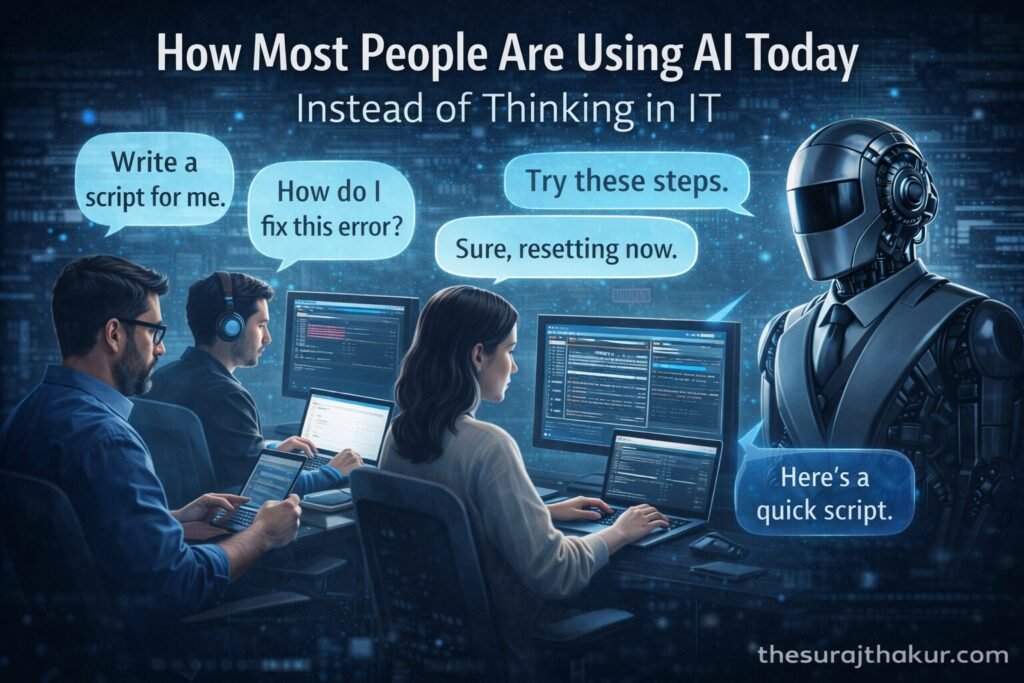
Most people described using AI the way they would use a very fast assistant.
They ask it to write emails.
They ask it to rephrase messages.
They ask it to explain something quickly.
Some ask it to generate code snippets or fix errors they do not want to spend time on.
A few even ask it to decide what is better when they feel unsure.
Across different ages, roles, and technical backgrounds, the pattern stayed the same. AI was mainly being used to finish tasks faster and to avoid spending effort on small things.
What stood out to me was not the type of tasks. Those are reasonable uses. What stood out was where the thinking stopped. In most cases, people were not using AI to explore a problem or understand it better. They were using it to reach an answer quickly and move on.
Almost everyone saw AI as something that works for them, rather than something that works with them. The focus was on output, not on the thought process. Speed mattered more than depth.
At this point, nothing felt dangerous or careless. It just felt shallow. Like using a powerful tool in the smallest possible way.
And that observation is where the real discussion begins.
Why Letting AI Handle Small Thinking Is a Problem
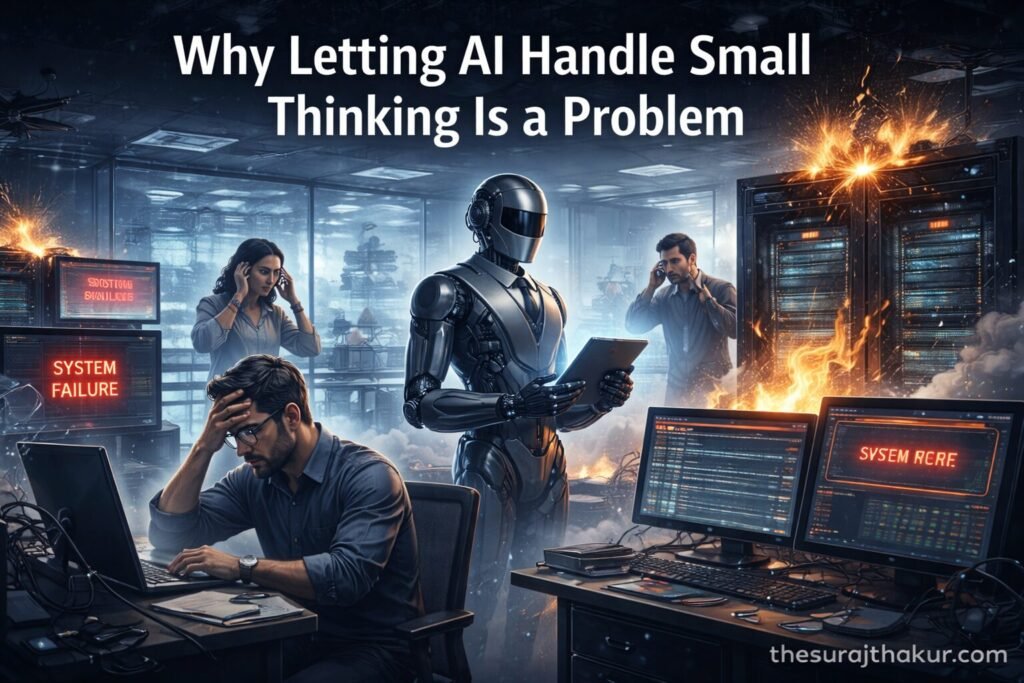
At first, offloading small tasks to AI feels harmless. Why spend time rewriting a message, thinking through a simple explanation, or debugging a minor issue when a tool can do it instantly?
That logic makes sense in isolation. The problem shows up when this becomes the default way of working.
Small thinking is not wasted thinking. It is where patterns form, where intuition builds, and where you stay familiar with the basics of your own work. When those small moments are repeatedly handed off, something subtle changes. You stop engaging with problems that are easy but important.
Over time, this creates a gap. People start feeling less confident tackling even simple decisions without assistance. Not because the problems are harder, but because the habit of thinking through them has weakened.
In technical roles, this shows up quickly. Simple issues that once took a few minutes to reason through now feel uncomfortable without help. Instead of asking “why is this behaving this way,” the first instinct becomes “let me ask AI.”
This is not about intelligence or capability. It is about muscle memory. Thinking, like any skill, weakens when it is not used regularly.
Used carefully, AI can reduce unnecessary effort. Used carelessly, it can quietly replace the everyday thinking that keeps you sharp.
AI Is Meant to Help You Think, Not Think for You
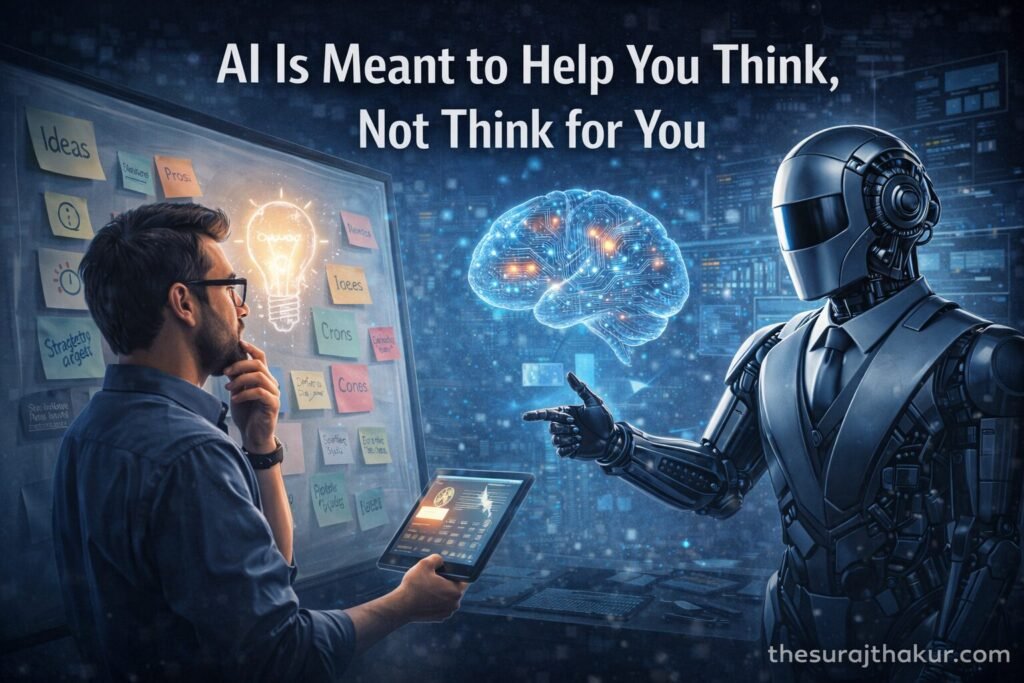
Once I started noticing how often people handed off small thinking to AI, the pattern became clearer. The issue was not usage. It was the mental model behind it.
Most people treat AI like something that replaces effort. You give it a task, it gives you an answer, and you move on. That model works for automation, but it breaks down when applied to thinking.
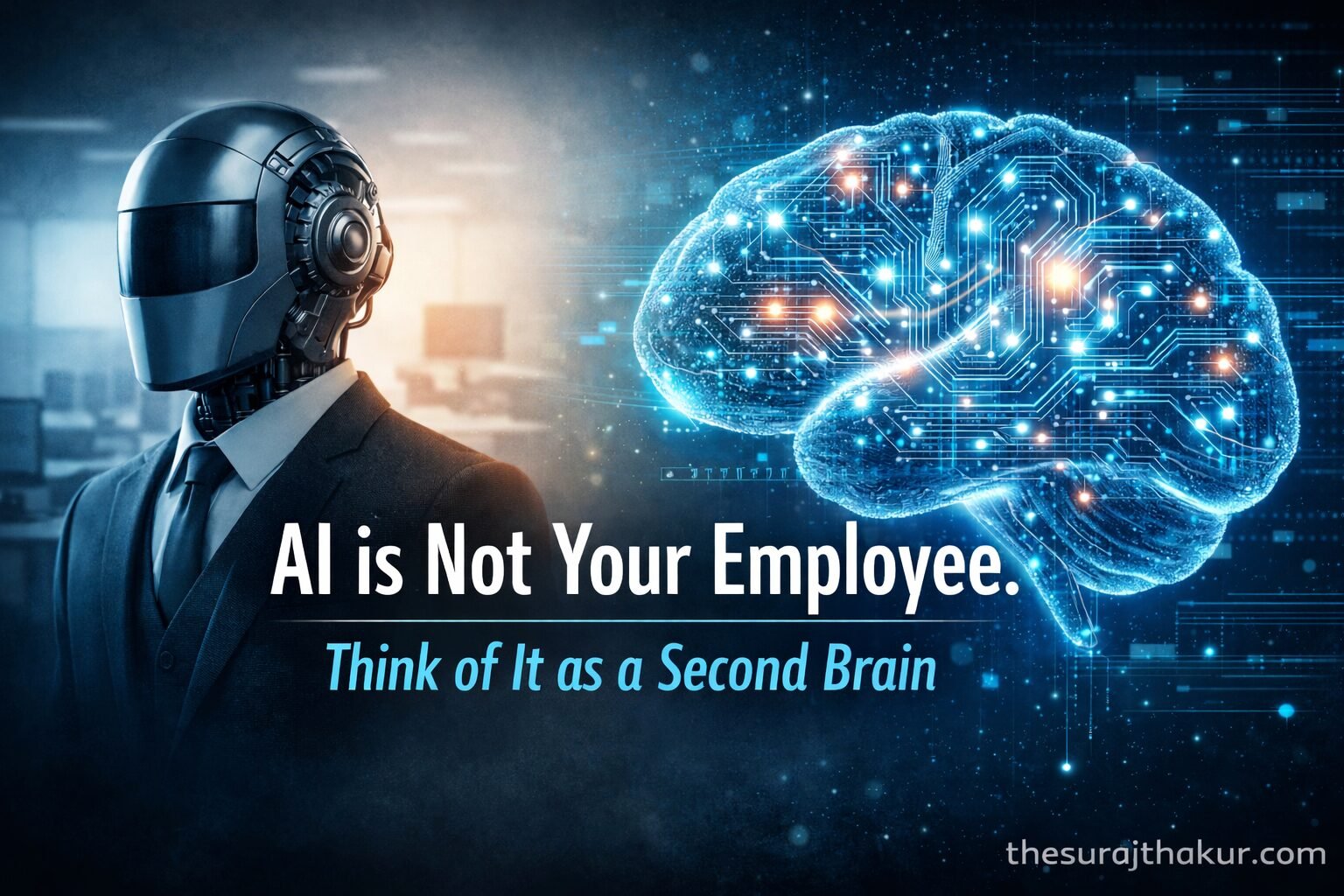
A better way to look at AI is as a second brain. Not a smarter one. Not a decision maker. Just a place where thoughts can be tested, expanded, or challenged.
When used this way, AI does not remove thinking from the process. It stretches it. You bring an idea, an assumption, or a half-formed thought, and you use the tool to push back on it. You ask it to point out gaps, alternatives, or risks you might be missing.
The difference is subtle but important. Instead of asking AI to give you the answer, you involve it in the reasoning. You stay responsible for the final decision.
This shift matters because judgment cannot be outsourced. AI can help you see more angles, but it cannot understand context the way you do. It does not carry the weight of consequences. That responsibility always stays with the person using it.
When AI is treated as a thinking partner rather than a replacement, it becomes far more valuable.
Where This Goes Wrong in Real IT Work

This gap becomes very visible in IT and engineering work, especially in areas where context matters more than answers.
I noticed this when people talked about using AI to debug issues, write queries, or suggest fixes. On the surface, it looks productive. A problem appears, AI gives a possible solution, and work moves forward.
The issue is what gets skipped in between.
In real systems, problems rarely exist in isolation. A slow service might be linked to traffic patterns, recent deployments, hidden dependencies, or data behaviour over time. When AI is used to jump straight to a fix, the understanding of why something broke often gets lost.
This shows up during incidents and production issues. People apply suggestions without fully reasoning through them. When the same issue reappears, they struggle to explain it, reproduce it, or prevent it. The system becomes something they operate, not something they understand.
Over time, this affects confidence. Engineers hesitate to trust their own judgment unless it matches what the tool says. Instead of forming a hypothesis and validating it, the habit becomes to ask first and think later.
AI can absolutely help in IT work, but only when it is used to support analysis, not replace it. The moment it starts skipping reasoning, it creates shallow fixes and fragile systems.
That is where the real cost shows up, not immediately, but over time.
What Using AI Properly Actually Looks Like

Using AI properly does not mean avoiding it or limiting it to trivial tasks. It means being intentional about where it fits in your thinking process.
In practice, this often means slowing down the interaction instead of speeding it up. Before asking for an answer, you start with your own understanding. You form a rough explanation, even if it is incomplete, and then use AI to challenge it.
In IT work, this can look like asking AI to review a theory rather than suggest a fix. Instead of “why is this service slow,” the question becomes “here is what I think is happening, what am I missing.” That small shift keeps you in control of the reasoning.
AI is also useful for exploring edge cases and alternative paths. It can help you think through scenarios you might not encounter immediately, or point out assumptions you did not realise you were making. This strengthens understanding rather than replacing it.
When used this way, AI becomes a force multiplier. It speeds up learning without skipping it. It helps you think wider without thinking less.
The output matters, but the process matters more. The real value comes from how much clearer your own thinking becomes after the interaction.
The Shift That Makes AI a Real Advantage
The biggest difference I noticed between average AI usage and high-leverage usage was not technical skill. It was mindset.
Some people approach AI as a shortcut. Others approach it as a lens.
The moment you stop asking AI to replace your effort and start using it to stretch your thinking, the value changes completely. You remain responsible for understanding the problem. AI simply helps you see it from more angles, faster.
In IT work especially, this shift matters. Systems are complex, messy, and full of context that no tool fully understands. The people who benefit most from AI are the ones who already engage deeply with that complexity and use AI to test, question, and refine their thinking.
Used this way, AI does not make you weaker. It makes you sharper. It does not reduce independent thought. It exposes where it is missing.
AI is not your employee. It was never meant to be.
It is a second brain. And like any second brain, its value depends entirely on how much you use your own first.
Closing Thoughts
AI is one of the most powerful tools we have access to right now, especially in technical work. The problem is not that people are using it. The problem is that many are only using a small part of what it offers.
When AI is treated as a shortcut, it quietly replaces moments of thinking that matter. When it is treated as a partner, it sharpens those same moments. The difference is not in the tool, but in how intentionally it is used.
For people working in IT, this distinction is critical. Systems do not just need fixes. They need understanding. AI can help you reach that understanding faster, but it cannot replace the responsibility to build it yourself.
Used properly, AI does not take thinking away from you. It pushes you to think better, wider, and more clearly. That is where its real value lies.
AI will shape the future of work.
But the future of your thinking is still in your hands.